
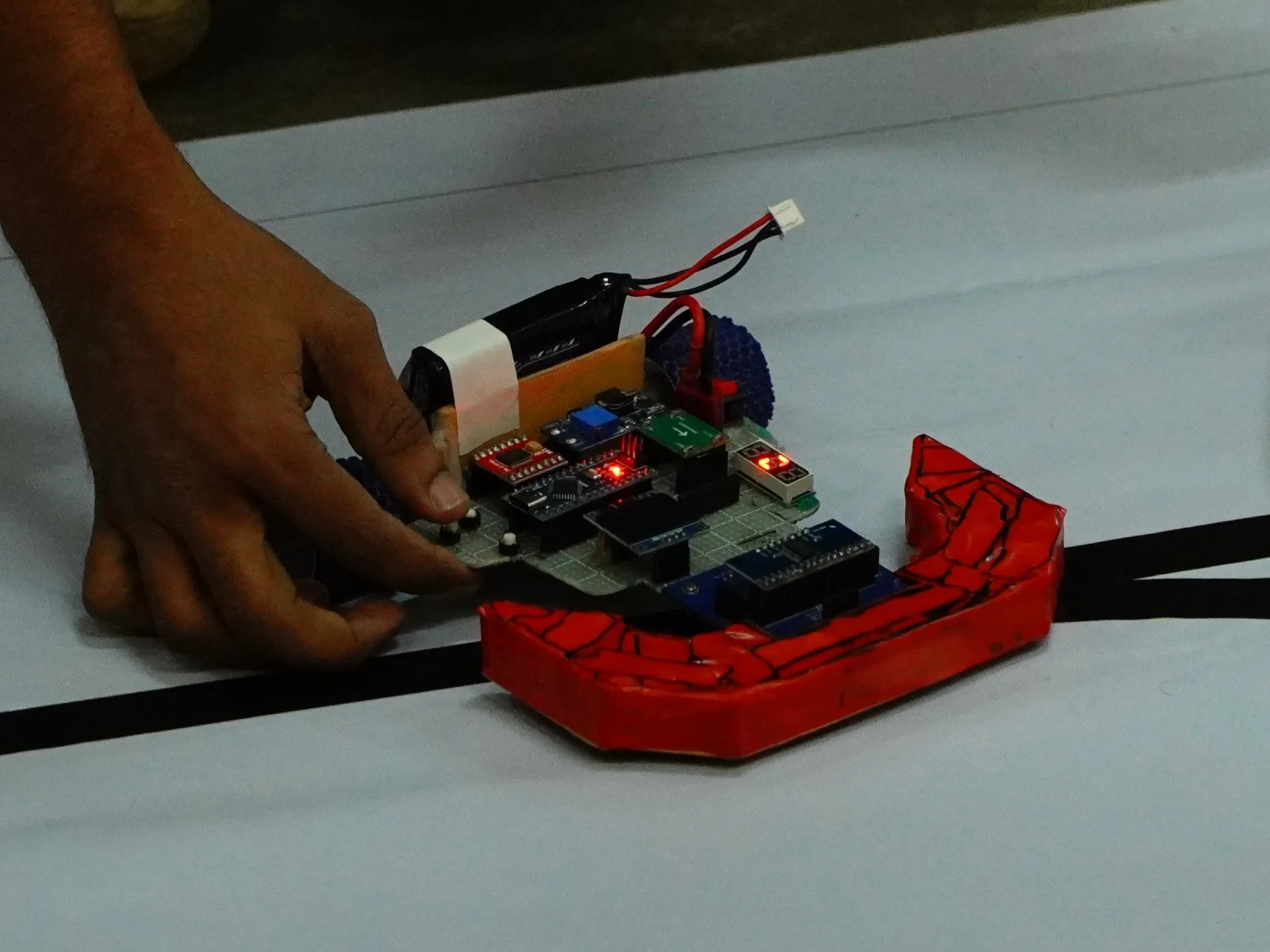
Line Following Robot
Robotics
Who can take part
Open to all students.
Details
Welcome to the Line Following Robot competition! Build a robot that follows the track faster and more accurately than the rest. Register by 10 December 2026, and read the rulebook for track rules and all other details.
Rules
1. Introduction
The Line Following Robot (LFR) competition is one of the most exciting events of the Ibn Ahmad al-Biruni Science Fest 2026. Here, students get the chance to show their robotics, programming and problem-solving skills in practice.
Participants must build and program a robot that follows the black line of a set track and reaches the finish as fast and as accurately as possible. Good robot design, sensor use and an effective algorithm will play a key part in getting through the track’s curves, sharp turns and checkpoints.
Through this event, Bangladesh Islami Chhatrashibir aims to encourage the technical knowledge, creativity and innovative thinking of young people. We hope this experience will help develop the skilled engineers and technology innovators of the future.
2. Eligibility and Participation
2.1. Eligibility
- All students may take part in the Line Following Robot competition.
- For identity verification, each participant must show a valid Student ID Card.
2.2. Team Requirements
- Each team must have a unique name.
- Participants may take part individually or by forming a team.
- A team may have a maximum of 3 members.
- Students from different institutions may form a team together.
- A participant may register as a member of only one team in this segment.
- All team members must be present to receive certificates.
- The team leader is fully responsible for the team’s decisions and conduct.
- Any team member may operate the robot.
3. Registration
- Registration deadline: 10 December 2026.
- Registration fee: 100 BDT per member.
4. Competition Format
- The number of rounds will be decided based on the number of participating teams and the overall situation of the event.
- The number of rounds and the detailed competition schedule will be announced on the event day.
5. Competition Rules
5.1. General Rules
- Every team must be present at the competition venue within the set time. A team that arrives late may not be allowed to compete.
- In each round, a maximum of one member from each team may enter the set area of the arena.
- Only members of registered teams may operate the robot.
- Every team must bring its own necessary tools and safety equipment.
- No outside communication device may be used during a round.
- Using the same robot for more than one team is strictly prohibited.
5.2. Robot Inspection and Submission
- Robots and team members will be inspected as needed before each round.
- Robots must be submitted to the authority for inspection at least 30 minutes before the competition starts.
- If a robot is submitted after the set time, a penalty or point deduction may apply, as decided by the judges.
- After submission, no change may be made to the robot’s hardware or software.
- However, minor repairs that can be made without any extra tools are allowed.
6. Technical Specifications
6.1. Maximum Robot Limits
Every robot must be built within the size, weight and power limits given below.
Table 1. Maximum robot size, weight and power limits
| Item | Set limit |
|---|---|
| Size | Max 25 × 25 × 20 cm (width × length × height) |
| Weight | Max 1 kg |
| Power supply | The robot’s own onboard power source (no wired power supply from outside) |
| Maximum voltage | 16.8 V |
6.2. Robot Requirements
To take part in the competition, every robot must meet the following requirements:
- Every robot must have a kill switch.
- A maximum of 4 switches may be used on a robot. If more switches are used, a penalty applies as decided by the judges.
- The robot must have a power switch.
- Ready-made commercial robots may not be used. The robot must be built by the team.
- Each team may use only one robot for the whole competition. The robot may not be changed after the first round ends.
- The robot must not damage the track through its movement or any other action.
- Any robot shape within the set dimensions is acceptable, but the robot must be two-wheeled.
- No wireless communication with the robot is allowed during a round.
- Four-wheeled or paddle-driven robots may not be used.
6.3. Arena and Track Layout
The competition track will be built to test the robot’s speed, accuracy and control. The track features are:
- The exact arena measurements and the chance to practise on a demo track will be announced on the event day.
- The track will be a black line on a white background.
- The track will have various curves, sharp turns and bonus checkpoints.
- The start and finish points of the track will be clearly marked.
- The black line will be 2.5 cm wide.
- The track may have round curves and sharp turns at angles such as 30°, 45°, 60° and 90°.
- The track will also have curves such as sine waves and square waves.
- The main competition track will not be published in advance, but it will match the design and features of the demo track.
7. Run Procedure
7.1. Run Start and Calibration
- In each round, the robot must be placed at the set starting point.
- The robot may be started by hand after the judge’s signal.
- The robot must start from the set starting point, follow the black line of the track and reach the finish correctly.
- Before each round starts, teams get 1 minute to calibrate the robot’s sensors.
- During calibration, the robot’s hardware or code may not be changed. Teams may only calibrate sensors using the code already on the robot.
- If more than the set 1 minute is taken, 10 points are deducted for each extra 30 seconds.
- The robot must be able to work in different lighting conditions.
- Every team must take the necessary steps so that sunlight, camera flashes or any other outside light do not disturb its sensors.
7.2. Restarts and Checkpoints
If the robot leaves the track or fails to run as set, it must be restarted under the following rules:
- If the robot loses the black line of the track, it must be started again from the last checkpoint it passed. The timer keeps running during a restart.
- If the robot stays stuck at any point for more than 15 seconds in a row, it must be restarted from the last checkpoint.
- If any team member touches the robot during a run, on purpose or by accident, it must be restarted from the last checkpoint at once.
- Each team may take a maximum of 5 restarts.
- No points are deducted for the first 2 restarts.
- From the third restart onward, 10 points are deducted for each restart.
- The maximum time for each run will be announced with the track on the event day.
- The run ends when the set time is over.
- If a team needs another restart after using 5 restarts, its run is considered over. Points earned until the run ended are kept.
- The track will have several checkpoints. The set mandatory checkpoints must be passed.
- Passing bonus checkpoints is not mandatory, but extra points are earned for passing them.
8. Scoring and Victory
8.1. Scoring System
Each team’s performance is judged on several factors, including passing checkpoints, the robot’s speed and accuracy, and reaching the finish within the set time.
- Points are awarded for passing the set checkpoints.
- Extra points are awarded for the robot’s speed and accuracy. The judges will set the detailed point values on the competition day.
- Bonus points are earned for completing optional checkpoints or special tasks.
- The judges will decide the penalty for leaving the track, going over the set time or breaking any other rule.
Table 2. Additional points
| Action | Points |
|---|---|
| Explaining the robot’s specifications and how it works | +25 |
| Passing each checkpoint | +25 |
| Reaching the set finish and stopping the robot | +20 |
| Completing the full run without any restart | +20 |
8.2. Ranking and Winner Selection
- At the end of the competition, the team with the highest total points wins.
- If two or more teams have equal total points, their run completion times are compared. The team that finished its run in less time ranks higher.
- If the run completion times are also equal, the team that took fewer restarts is considered the winner.
9. Violations and Disqualification
Keeping discipline and fairness in the competition is every participant’s responsibility. A participant or team may be disqualified from the competition for any of the following:
- Misconduct towards judges, organizers or any other participant.
- Disrespectful behaviour towards judges or opponents.
- Making insulting or offensive remarks about anyone.
- Any behaviour that spoils the fair environment of the competition.
In such situations, the decision of the judges and organizers is final.
10. Safety, Conduct and Fair Play
Keeping participants, organizers and equipment safe is everyone’s responsibility. Every team must therefore follow these rules:
- Kill switch: every robot must have a kill switch (section 6.2).
- Tools and safety equipment: every team must bring the necessary tools and safety equipment (section 5.1).
- Team conduct: every member must treat judges, organizers and other participants with respect (section 9).
If the safety and conduct rules are broken, the authority may take the necessary action.
11. Awards and Recognition
- Prize details for each segment will be announced before the competition.
- The winners’ total prize pool across all segments of the Science Fest is 800,000 BDT.
- Prizes and recognition will be given according to the winners’ achievements.
12. Amendments and Final Authority
- To run the competition smoothly, the organizers reserve the right to amend or change the rules at any time if necessary.
- If any rule is amended or changed, participants will be informed.
- On any matter concerning the competition, the decision of the organizers and judges is final.
13. Official Contact
For any question, information or help about the competition, contact our Facebook page.
- Facebook page: facebook.com/scienceDept.BICS
- Venue: the event venue and other necessary information will be announced on our Facebook page.
Register your team
Please fill in every field in English. The Team Leader fills this in for the whole team.