
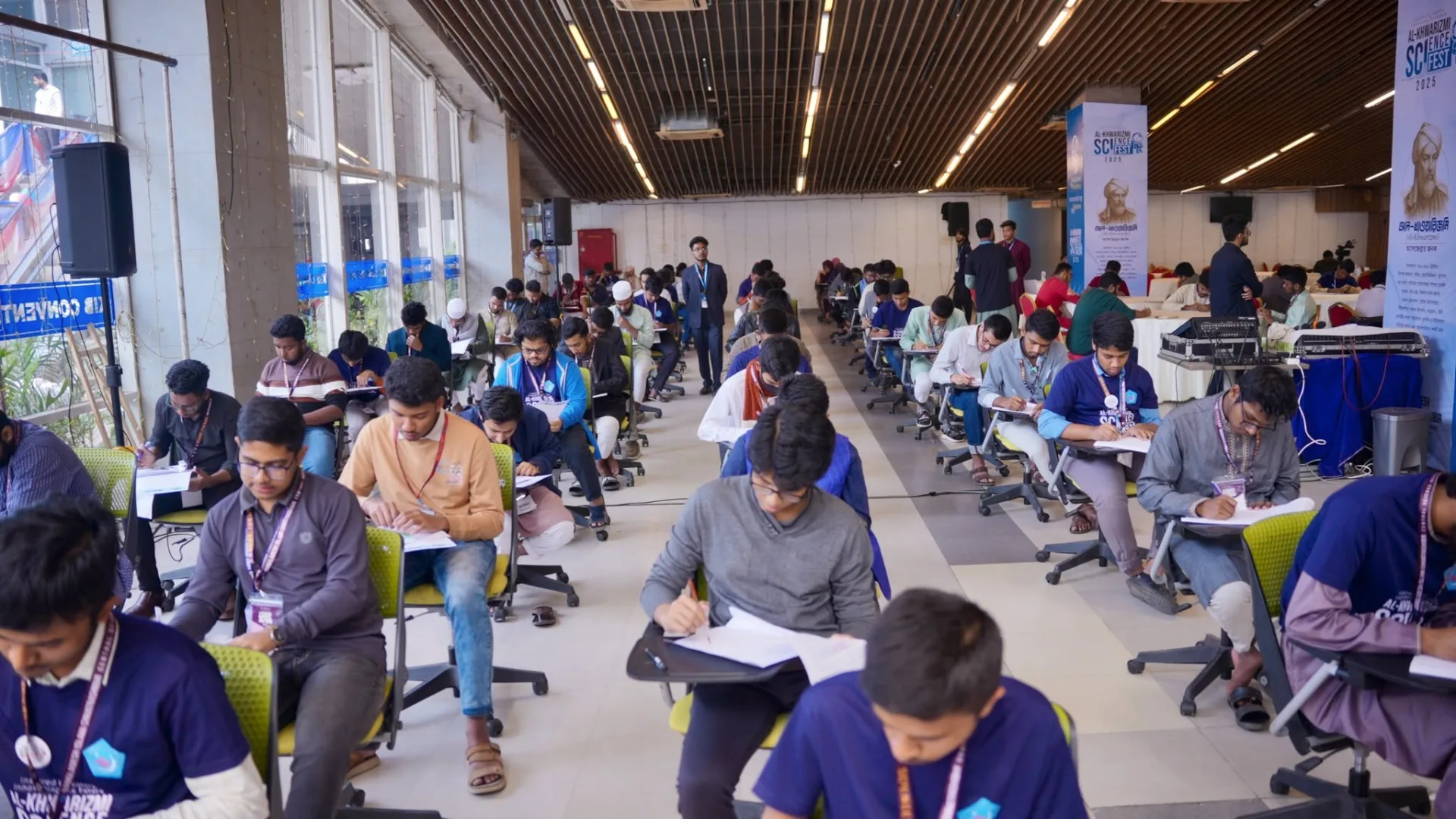
Physics Olympiad
Olympiad
Details
Welcome to the Physics Olympiad! Test your physics knowledge against students of your level. Register by 10 December 2026, and read the rulebook for groups, rounds and all other details.
Rules
1. Introduction
The Physics Olympiad is an excellent chance for school and college students to test their knowledge of physics and show their analytical and problem-solving skills. A key aim of the competition is the ability to apply the principles of physics to real situations, beyond the limits of the usual textbooks.
The Olympiad encourages students from an early age to be curious, think logically and develop a love of science. Participants must apply physics concepts clearly and accurately to solve a range of problems.
The aim of this initiative by Bangladesh Islami Chhatrashibir is to inspire young students to contribute to future scientific progress by developing their knowledge, creativity and confidence.
2. Eligibility and Participation
2.1. Eligibility
- All students studying from Class 6 to Class 12 (HSC or equivalent) may take part in this Olympiad. Students of equivalent classes in English-medium schools and madrasahs may also take part. Polytechnic students in their 1st or 2nd year may also take part and count as Class 11–12 (Group 3).
- For identity verification, each participant must show a valid Student ID Card, admit card or the ID card of their own institution.
- A participant must compete in the group set for the class they are studying in at the time of registration.
2.2. Groups
Participants are divided into three groups by class.
Table 1. Physics Olympiad groups
| Group | Classes that can take part |
|---|---|
| Group 1 (Junior) | Class 6 to Class 8 or equivalent |
| Group 2 (Secondary) | Class 9 to Class 10 or equivalent |
| Group 3 (Higher Secondary) | Class 11 to Class 12 (HSC or equivalent); polytechnic 1st and 2nd year |
2.3. Participation Conditions
- This is an individual competition. There is no team or group participation.
- Each participant may register in only one group.
- No one may take part in a group below their current class.
- All details, including name, class and institution name, must be given correctly at registration. A participant who gives wrong or false information may be disqualified.
3. Registration
- The registration deadline is 10 December 2026.
- The registration fee is 100 BDT per participant.
- After registering, each participant receives a unique registration number. This number must be used to log in to the preliminary round exam. It will also appear on the final-round admit card of selected participants.
4. Competition Format
For each group, the Physics Olympiad is held in two rounds. First, an online preliminary exam is held. Participants selected in this round then get to take part in the written final round, held in person.
Table 2. Competition rounds
| Round | Exam mode | Duration | Question type | Date |
|---|---|---|---|---|
| Preliminary round | Online | 1 hour | 30 multiple-choice questions (MCQ) | Will be announced |
| Final round | Written, in person | 2 hours | Written problems | 18 December 2026 |
4.1. Preliminary Round
- A separate online exam is held for each group. The exam lasts 1 hour and has 30 multiple-choice questions (MCQ).
- Each question has four options, one of which is correct.
- Before the exam, registered participants will be sent the exam link and login instructions.
- The exam starts and ends at the same set time for all participants in a group. No extra time is given for a late login.
- When the set time ends, answers are submitted automatically.
- Exam questions will be in both Bangla and English.
4.2. Selection for the Final Round
- Participants are selected separately from each group based on their preliminary round marks.
- The top 150 scorers from each group get to take part in the final round.
- The list of selected participants will be published on the organizers’ official Facebook page.
- Each selected participant must download or collect their admit card before the set time.
4.3. Final Round
- The final round is held on 18 December 2026. A separate 2-hour written exam is held for each group.
- Answers must be written as full solutions, with reasoning, calculations, explanations and diagrams as needed.
- The reporting time for the exam will be printed on the admit card.
- The question paper will be in both Bangla and English.
5. Rules and Regulations
5.1. Preliminary Round Rules
- Each participant must take the exam entirely alone. No help from anyone else is allowed.
- No books, notes, websites, AI tools or messaging apps may be used during the exam.
- One registration number may be logged in from only one device at a time.
- Participants are responsible for having a working device and a stable internet connection. Exam time will not be extended for problems with a participant’s own device or internet.
- Sharing questions or answers with others during the exam is strictly prohibited. A participant found doing so will be disqualified.
5.2. Final Round Rules
- Each participant must arrive at the exam center within the set time. Late arrivals may not be allowed to sit the exam.
- Participants must bring their admit card and a valid Student ID Card to the exam.
- Each participant must bring their own pen, pencil, eraser, ruler and geometry box.
- Only Group 2 and Group 3 participants may use a basic non-programmable scientific calculator. Group 1 participants may not use a calculator of any kind.
- Mobile phones, smartwatches or any other electronic or communication devices may not be brought into the exam hall.
- Talking, copying or sharing any materials with others during the exam is strictly prohibited.
- All instructions given by the invigilators during the exam must be followed.
- No participant may leave the exam hall during the first 30 minutes or the last 15 minutes of the exam.
- Before leaving the hall, each participant must hand their answer script to the invigilator.
6. Syllabus
Questions in both rounds are set from the syllabus below. Each group has its own syllabus.
6.1. Group 1 (Junior)
- Measurement and Data: measuring length, area and volume with slide calipers and screw gauge (micrometer); basic idea of errors in measurement and their correction; SI units and scientific notation.
- Structure of Substances: concept of atoms and molecules; molecular structure of solids, liquids and gases; intermolecular distance and force; change of state (melting point, boiling point).
- Mechanics: distance, displacement, speed, velocity and acceleration; Newton’s laws of motion and conservation of momentum; work, power, kinetic energy and potential energy; gravitation and gravity, acceleration due to gravity (g), difference between mass and weight; simple pendulum and periodic motion.
- Fluids and Pressure: density, pressure and pressure inside liquids; Pascal’s law and the hydraulic press; Archimedes’ principle, buoyancy and conditions for floating; atmospheric pressure, barometer and manometer.
- Heat: temperature and units of heat (calorie, joule); thermometers and temperature scales (Celsius, Fahrenheit, Kelvin); thermal expansion of materials (linear, area and volume expansion); heat transfer (conduction, convection and radiation); ideal gas laws (Boyle’s law and Charles’s law).
- Waves and Sound: general properties of waves (frequency, wavelength, amplitude); speed of sound, audible range, ultrasonic and infrasonic waves, and echo.
- Light and Optics: reflection of light (plane and spherical mirrors, image formation); refraction of light, Snell’s law, critical angle and total internal reflection; refraction and dispersion of light through a prism (spectrum).
- Electricity and Magnetism: electric charge, Coulomb’s law and electric field; Ohm’s law, combination of resistances (series and parallel), electric power; magnets, magnetic field, magnetic field lines and geomagnetism.
6.2. Group 2 (Secondary)
- Mathematics and Vectors: scalar and vector quantities, dot and cross product, components and polar coordinates; basic ideas of differentiation and integration, slope, maxima and minima; trigonometry, binomial expansion (Taylor and Maclaurin series approximation) and probability.
- Advanced Mechanics: center of mass and moment of inertia; parallel and perpendicular axis theorems; two-dimensional motion: projectile motion and centripetal force; friction (static and kinetic) and viscous force; collisions: elastic and inelastic (one and two dimensions).
- Gravitation and Astronomy: gravitational potential and field, shell theorems; escape velocity, motion of artificial satellites and Kepler’s laws.
- Fluids and Waves: surface tension and capillarity; Bernoulli’s theorem and the continuity equation; waves: intensity, power, superposition, standing waves, interference and diffraction.
- Thermodynamics: zeroth, first and second laws of thermodynamics; internal energy and entropy; Stefan–Boltzmann law and molar heat capacity.
- Advanced Electricity and Magnetism: electrostatics: Gauss’s law, electric flux, capacitors (spherical, parallel plate) and dielectrics; current electricity and magnetism: AC circuits, impedance, RMS voltage, Faraday’s law of electromagnetic induction, Lenz’s law, transformers, LCR circuits and resonance.
- Modern Physics: particle nature of light, photons and the photoelectric effect; atomic models, X-rays and the mathematical form of radioactivity.
6.3. Group 3 (Higher Secondary)
- Mechanics and Kinematics: vector displacement, velocity and acceleration; equations of uniformly accelerated motion, projectile motion, circular motion and relative velocity; Newton’s laws of motion, free-body (force) diagrams, momentum and impulse, conservation of momentum; definition of work, work done by a variable force, kinetic energy, potential energy and conservation of energy; moment of inertia, parallel and perpendicular axis theorems, torque, angular momentum and its conservation, rotational kinetic energy; Newton’s law of gravitation, gravitational field and potential, escape velocity, Kepler’s laws of planetary motion and satellite motion; inertial and non-inertial frames: pseudo force, centripetal and centrifugal force, and a basic idea of the Coriolis force.
- Properties of Matter and Fluids: Hooke’s law, stress, strain, Young’s modulus and other elastic moduli, stored elastic energy; Pascal’s law, Archimedes’ principle and buoyancy, viscosity, Stokes’ law, continuity equation and Bernoulli’s theorem; surface tension: surface energy, capillarity and excess pressure inside bubbles.
- Heat and Thermodynamics: temperature measurement, thermal expansion (linear, area, volume) and thermal conductivity; kinetic theory of gases: ideal gas, RMS velocity of molecules, relation of kinetic energy with pressure and temperature; zeroth, first and second laws of thermodynamics; isothermal and adiabatic processes; Carnot cycle; efficiency of heat engines and refrigerators; entropy; black body radiation, Wien’s displacement law and Stefan–Boltzmann law.
- Waves and Oscillations: simple harmonic motion (SHM), spring and simple pendulum motion, energy conversion; properties of waves, principle of superposition, standing waves (nodes and antinodes), interference, diffraction and the Doppler effect; speed and intensity of sound, infrasonic and ultrasonic waves.
- Electromagnetism: Coulomb’s law, electric field and potential, Gauss’s law, capacitors and dielectrics; Ohm’s law, Kirchhoff’s laws, combination of resistances, electric power, Joule heating, potentiometer and Wheatstone bridge; magnetic field, Biot–Savart law, applications of Ampère’s law, Lorentz force, Faraday’s law of electromagnetic induction and Lenz’s law; alternating current, RMS values, reactance, impedance, series and parallel LCR circuits, and electrical resonance.
- Optics: reflection and refraction of light, Snell’s law, prisms, power and combination of lenses, optical instruments (microscope and telescope); wave theory of light, Huygens’ principle, Young’s double-slit experiment and polarization of light.
- Modern Physics: Einstein’s postulates, length contraction, time dilation and mass–energy equivalence; photoelectric effect, Planck’s quantum theory, X-rays and de Broglie matter waves; Bohr’s atomic model, radioactive decay law, half-life, mean life, nuclear fission and fusion, mass defect and binding energy.
7. Ranking and Marking
7.1. Preliminary Round Marks
- Each correct answer earns 5 marks. The maximum for 30 questions is 150 marks.
- Marks are deducted at a set rate for each wrong answer. The deduction per wrong answer will be announced before the exam starts.
- An unanswered question earns 0 marks.
7.2. Final Round Marks
- The marks for each question will be shown on the question paper.
- Partial marks may be given if the correct reasoning and method are followed, even when the final answer is wrong.
- Only final round marks are considered in deciding the winners.
7.3. Deciding the Winners
- Results and winner rankings are decided separately for each group.
- The participant with the highest marks in the final round wins.
- On any matter of marking and results, the judges’ decision is final.
8. Violations and Disqualification
A participant may be disqualified at any stage of the competition for any of the following irregularities or misconduct.
- A participant who uses unfair means or breaks the exam rules in any round will be disqualified.
- If anyone is proven to have sat the exam for someone else, or under someone else’s identity, both that person and the person whose identity was used will be disqualified.
- Misconduct, disrespect towards invigilators or other participants, or causing disorder in the exam hall will lead to disqualification.
- A participant who gave wrong or false information at registration may be disqualified at any stage, even after the results are published.
9. Conduct and Fair Play
To ensure a fair competition for everyone, every participant must follow the set rules. The following sections apply.
- Preliminary round conduct and exam rules: section 5.1.
- Final round conduct and permitted materials: section 5.2.
- Violations and disqualification: section 8.
10. Awards and Recognition
- Prizes, crests and certificates will be given to the winners of each group.
- Every student who takes part in the final round will receive a participation certificate.
- Prize details for each segment will be announced before the event.
- The winners’ total prize pool across the Science Fest is 800,000 (eight hundred thousand) BDT.
11. Amendments and Final Authority
- The organizers reserve the right to amend or change the competition rules if necessary. Participants will be informed of any such change.
- In any situation or problem not covered by this rulebook, the decision of the organizers and judges is final.
12. Official Contact
- For any question about the competition, message our official Facebook page: facebook.com/scienceDept.BICS
- The venue will be announced on the same Facebook page.
- All updates on registration, exam links, results and other competition matters will be published on the official Facebook page.
Register
Please fill in every field in English.